Friday, May 23, 2008

You Know What They Say About Glass Houses...


At over half a billion years old, sponges are the oldest multi-cellular animals on the planet. Scientists have identified thousands of species, and believe there are many more yet to be found. Indeed, the NOAA Ocean Explorer recently discovered a new marine sponge, dubbed “Bill Clinton,” as it apparently resembles the former US president’s hair-do.

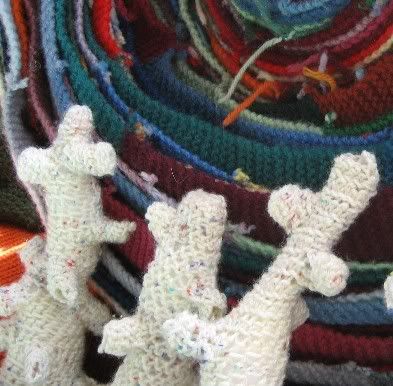
Sponges have a very simple anatomy, and don’t form tissues or organs. But Hexactinellid, or glass sponges also boast some of the most complex skeletons known to science, far stronger than any feats of human architecture. These creatures use intricate arrangements of tiny needle-like shards of silica (known as spicules), layered with glue, to create their reinforced cage-like skeletons.

These unique skyscrapers of the sea provide excellent homes and make great nurseries for a wide range of fish, crustaceans, and other organisms. As a very slow growing species, glass sponges are particularly vulnerable to destruction by bottom trawling. These crocheted specimens are happily safe from harm in the window of The Loop, in downtown Halifax, where they serve as habitat for a growing swath of crafted critters.

Friday, May 16, 2008

Happy Endangered Species Day?

With so many sea creatures at risk of extinction, it is heartening to hear that new species continue to be discovered. Actually, more new animals are found every year in marine environments than any other. But this is no reflection of ocean health – rather, it illustrates how very little we know about life in the ocean, especially the deep sea. In fact, global populations of marine species plummeted by 28% in just 10 years, according to the Living Planet Index.
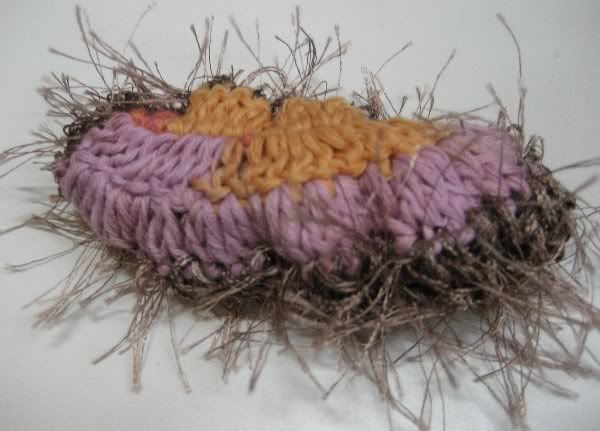
Last summer, Canadian researchers from DFO and Memorial University rented a powerful submersible camera to explore the fascinating depths of Sable Gully. They came back with the most incredible photos! This exciting voyage also revealed several species not previously known to science, including this stunning file shell from the family Limidae. (Photos courtesy of DFO. Crocheted Limidae made by Morgan. )

The Sable Gully is a deep underwater valley located about 200 kilometres from the shores of Nova Scotia. Here on the edge of the Scotian Shelf, the sea floor suddenly drops over two kilometres, revealing a canyon almost 70 kilometres long and 20 kilometres wide. The Gully, now designated as a Marine Protected Area, is home to a rich and unique diversity of marine habitats and species. An integral part of ocean zoning, marine protected areas have a critical role to play in the conservation and protection of ocean life.
Tuesday, May 13, 2008

Voyage to the Bottom of the Sea

Look at this marine biodiversity! I feel all warm and fuzzy inside. It's just like Claire Nouvian described: "Down at the bottom of the oceans, there are forests of corals extending over hundreds of square kilometers, sheltering an infinitely rich and varied fauna. Sharks and cephalopods lay their eggs there; giant gorgonians offer their branches as promontories for echinoderms; delicate sponges welcome crustaceans and fishes."

But these animals don't just exist to be pretty. Marine ecosystems play a crucial role in life-sustaining global processes. The ocean provides carbon capture, climate change buffering, and coastal protection, among other functions. It also offers a staggering amount of food, pharmaceuticals and other stuff that is vital to our well-being. The ability for the sea to supply these essential "goods and services" depends on complex and mysterious relationships between organisms and their environments -aka marine biodiversity.

Come visit our marvelous and growing Northwest Atlantic sea floor. The Loop Craft Cafe is located on 1547 Barrington Street in Halifax, Nova Scotia. Thanks to everyone who has lent or donated sea creatures to the project so far. We look forward to your contributions!

(Bonus points for anyone who can pick out the lumpfish!)

Monday, May 12, 2008

"With fronds like these, who needs anenomes?"

They may appear a little… vegetative, but once you get to know them, sea cucumbers (Holothuria) are fascinating creatures. These pickle-shaped echinoderms lay on their side, using five rows of tube-feet along their body to get around. They make use of another set feet around their mouth to gather particles of plankton and other organic matter.

Amazingly, sea cukes protect themselves from predators by expelling their internal organs out of their butts! This works to either frighten (disgust?) or satisfy the appetite of their predators, and they simply grow a new set of viscera over the next two to six weeks. This regenerative ability holds incredible medical potential, leading most recently to the development of artificial corneas. As well, a protein found in sea cucumbers may hold promise in the fight against malaria.

Despite a stodgy appearance, sea cucumbers are considered a delicacy in many Asian communities. Nicknamed ‘ginseng of the sea”, many believe they are endowed with aphrodisiac powers. In Korea and Japan, bits of sea cuke innards are eaten raw or pickled. The body is also dried and sold as beche-de-mer.

Holothuria tend to be vulnerable to overfishing- and as Asian markets overexploited stocks closer to home, markets have ventured further and further afield. Today there is a relatively new "exploratory" sea cucumber fishery here in Nova Scotia. Modified scallop dredges lift them off the sea floor, along with various other bottom dwellers. (Photos courtesy of The Intersection. Critter courtesy of Naomi.)

Thursday, May 8, 2008

The Metamorphosis

What a mug. Flounders aren’t born with such wonky eyes. When they hatch as larvae they swim in the usual fishy way, but, like all flatfish species, they undergo startling bodily changes at a certain age. One of their eyes migrates to the other side of the body, and they begin to swim around on one flat side. And you thought think human puberty was traumatic! (Photo courtesy of Jeff Rotman.)

Flounders live close to the sea floor, using sophisticated colour-changing pigments to blend in with their surroundings. Most flounders have relatively small mouths, and must hide patiently along the the bottom, ambushing miniature meals of crustacean, shellfish, or polychaete worms.

Atlantic flounders turn up at supermarkets and on menus under many names, including Blackback, Dab, Fluke, Gray Sole, Lemon sole, Rusty flounder, Summer flounder, Windowpane flounder Winter flounder, Witch flounder, and Yellowtail flounder. However, they are naturally vulnerable to fishing pressure, and after a long history of overfishing, habitat damage and bycatch, most stocks remain depleted. You can read the SeaChoice assessment here, and browse the “Best Choice” list for sustainable seafood alternatives.

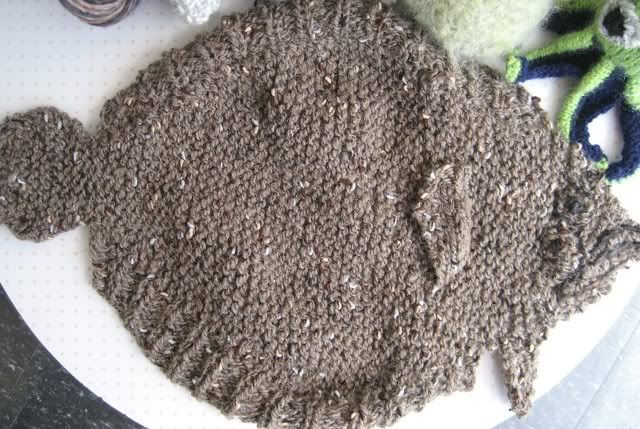
This fuzzy flounder recently turned up at the Loop Craft Café, where we are about to set up a Northwest Atlantic sea floor display in their front window. With just under a month until Ocean Day, now the time to get crafting, and help us populate our diverse, fibrous ecosystem. Check our wishlist and pattern resources along the right, or feel free to call us at the Ecology Action Centre, at (902) 446 4840.

Monday, May 5, 2008

Heaven on the half shell

"If you don't love life you can't enjoy an oyster; there is a shock of freshness to it and intimations of the ages of man, some piercing intuition of the sea and all its weeds and breezes. (They) shiver you for a split second.” So says novelist Eleanor Clark, and the marine team here at the Ecology Action Centre tend to agree, whenever we get the chance.

In Atlantic Canada, at the tip of its northern range, the Eastern Oyster (
Crossostrea virginica), has been found in warm, shallow bays and estuaries, along with the coves of the beautiful Bras d'Or Lakes in Cape Breton. As oysters die off, they form an impressive reef that can provide complex habitat for many organisms. As filter feeders, these crusty bivalves can also play a vital role in improving water quality. Unfortunately, many of Nova Scotia's native oyster reefs have disappeared as a result of introduced diseases, pollution, and dredging.

Lucky for sustainable seafood lovers, today there are several oyster farming operations in Atlantic Canada. Low-density farmed oysters have been given a “Best Choice” rating by SeaChoice, Canada's Sustainable Seafood program. Click here to read more about the assessment, and ShanDaph, a remarkable oyster operation in Merigomish, Nova Scotia (pictured left).

Though our crocheted specimen flaunts a pretty pearl button, Crossostrea virginica are not so renowned for their accessories. Many bivalves make pearls to seal off irritants in their shells, but only a few species polish them off with the nacre sheen sought for posh necklaces and earrings.

Wednesday, April 30, 2008

Mighty Aphrodite

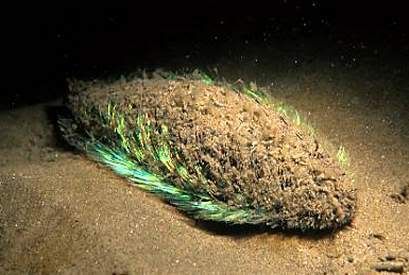
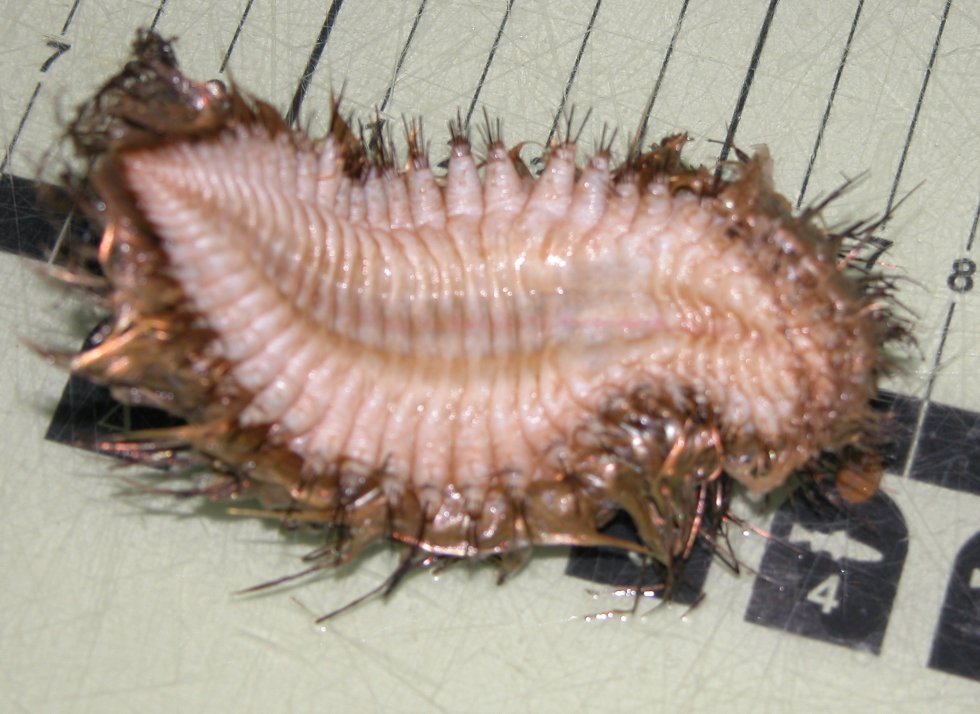
Believe it or not, the fuzzy creature pictured left is actually a worm, closely related to the earthworm. The great taxonomist Linnaeus named it Aphrodite aculeate. While one might hope he was appreciating the animal’s iridescent beauty, it seems that he was attempting a lame and tasteless joke.

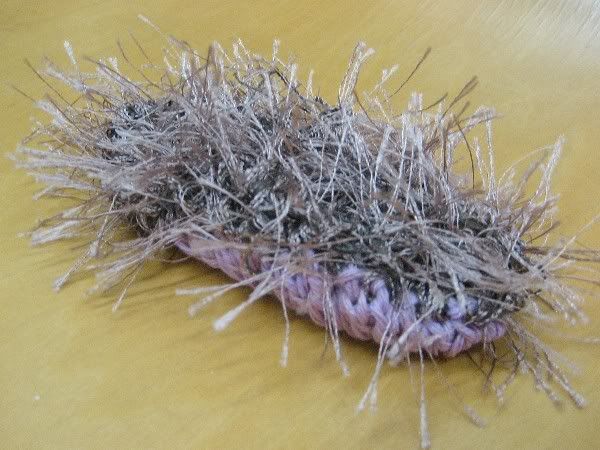
The common name “Sea Mouse” likely arose because of Aphrodite aculeate’s resemblance to the furry rodent when washed up on shore or in fishermen’s nets. The sea mouse sports a dense mat of deep red or brown hairs on its back, finer iridescent blue-green bristles along its sides, and pink segmented flesh more akin to its earthworm cousin along its belly. (Photos courtesy of Paul Kay, the University of Massachusetts, and The Loop.)

This unassuming marine worm has lately been receiving a flurry of attention from optical engineers. It seems that Aphrodite’s spines are made up of very specialized hexagonal cells that are incredibly efficient at trapping light. In this way, the bottom-dwelling Sea Mouse captures the limited light available on the ocean bottom in her fancy bristles to create send signals to predators that suggest her bristles are poisonous (they are actually harmless). These photonic crystals are the first ever found in a living organism, and researchers hope to copy their structure and revolutionize fibre optic communications.

A further flurry of Sea Mouse attention has recently erupted here at the Ecology Action Centre, all because of the magic of local crochet wizard named Morgan. Not only has she crafted a magnificent specimen for our sea floor, but she has also provided a free, easy-to-read pattern! Click here to see the pattern and more information about the Sea Mouse on the Loop Craft Café’s great blog.

As the lyrical natural historian Sue Hubbell has pointed out, it is maybe fitting that Aphrodite aculeata, ''an advanced and specialized Polychaete, should echo the name the Greeks gave to the generative and creative principle that had emerged from the sea's depths.'' After all, as she notes, ''Aphrodite, the name, derives from the Greek word for sea foam, aphros.''

Tuesday, April 29, 2008

The Bubblegum Years

Ahhhh, coral. For most of us, the word conjures a warm breeze, a snorkel, and shallow aquamarine reefs. Tropical corals are some of the most beloved and well-researched ecosystems on a planet - after all, who doesn’t want to conduct research in a speedo?

It may be surprising to many that in the chilly, dark waters off the Atlantic Canadian coast, we host our own variety of coral communities. While scientists have only recently begun to learn about cold-water corals, fishermen along the continental shelf have been aware of their existence for generations. Known to bottom hook-and-line fishermen in Nova Scotia as “trees,” Paragorgia arborea and Primnoa resedaeformis, among other species, have long been regarded as vital fish habitat.

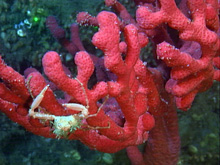
Paragorgia arborea (AKA Bubblegum trees) are considered to be the world's largest seafloor organism. Colonies can reach over seven metres high, and live for hundreds of years. They function as an oceanic treehouse, providing shelter for countless species of fish and invertebrates. Due to their upright nature and slow growth rates, Bubblegum corals are very sensitive to impacts from bottom trawling.

Back in 1996, a group of concerned fishermen on the South Shore of Nova Scotia formed an education and advocacy group called the Canadian Ocean Habitat Protection Society (COHPS). The group created a fantastic mounted display of collected coral specimens, and toured it around local schools, parades, and gatherings on the back of a pick up truck. ((Photos courtesy of the NOAA and Derek Jones.)

The important work of COHPS quickly reached the ears of the Ecology Action Centre and Dr. Martin Willison at Dalhousie University, and lead to the first International Deep Sea Coral Symposium in 2000. Today, there are two fishery closures and a Marine Protected Area designed to protect some of the coral on the Scotian Shelf.

For more about cold-water corals, keep your eyes on the Deep Sea News, as they are posting all kinds of fascinating coral stuff this week- from the latest science to the downright biblical.

Wednesday, April 23, 2008

Turtle Power

Look who has decided to join us! A gorgeously felted leatherback turtle, courtesy of The Loop.

The majestic leatherback is the largest of living turtles. As the late marine scientist Dr. Ransom Myers (pictured below) has described, they can grow "as big as Volkswagens." They are easily distinguished from other sea turtles by their lack of a hard shell, and long, clawless flippers.

Leatherbacks are major travelers, nesting on warm South and Central American beaches, and swimming north each summer to feed on jellyfish off the coast of Nova Scotia. To brave the cold northern waters, their flippers feature 'countercurrent heat exchangers'. If only we were also bestowed with such practical equipment to warm our feet during the long Maritime winter!

Listed as critically endangered by the IUCN and Canada's Species At Risk Act, these gentle giants can become ensnared in fishing gear, or caught on pelagic long lines. Leatherback turtles are also at risk from marine pollution. They may mistake floating plastic for jellyfish and fill their bellies with our indigestible garbage - eventually choking or starving. They are also sensitive to light and noise disturbances when nesting in the south.


The Canadian Sea Turtle Network (formerly known as the Nova Scotia Leatherback Turtle Working Group) is a collaborative research and conservation initiative that includes fishermen, tour-boat operators, naturalists, coastal community members, and biologists. The team has been tracking the trans-Atlantic voyages of a small number of tagged turtles in the hope of contributing to the recovery of the leatherback turtle.

Tuesday, April 22, 2008

The Ocean's Only Flying Elephant

Allow us to present the darling of unusual marine animal enthusiasts: the Dumbo Octopus. Doesn't she look fantastic?! This little critter was knitted for us using a pattern from Hansigurumi.

Grimpoteuthis, AKA Dumbo Octopus, are a recent scientific discovery, so-named for their delightful ear-like fins. These fins are used in combination with eight pulsing arms and a water funnel to hover elegantly, just above the sea floor. From there they can browse for worms, shellfish and copepods.

The Department of Fisheries and Oceans recently caught one on camera during an exploratory voyage into Sable Gully. This deep canyon is located just 200 kilometers off the coast of Nova Scotia, and is home to thousands of amazing species. Dumbo octopi living there should be relatively safe from human impacts, because Sable Gully has been designated as a Marine Protected Area since 2004.


(Knitted dumbo courtesy of Mammals. Photo courtesy of David Shale.)

Monday, April 21, 2008

Even A Small Star Shines in the Darkness

Wondering how to knit a brittle star? Look no further, because the lovely staff at The Loop Craft Cafe have come up with another great pattern, here. What a handsome creature!

Brittle stars are the fastest moving of all echinoderms. They crawl around on the sea floor using all five of their long, slender arms. They like to hide away around coral structures, and emerge at night to feed on plankton.Here is a bit of a gross fact for you: Brittle stars go without an anus, and eliminate their wastes through their mouth!

As their name suggests, brittle stars are pretty breakable. Far from being a handicap, it allows these nimble creatures to shed a limb or two and escape if cornered by a hungry predator like cod or haddock. They regenerate quickly, and can grow a whole new organism from just a small surviving piece. Watch some pretty footage of a crawling brittle star here.

Friday, April 18, 2008

Jelly Dimensions

As Beau Sheil has said, "Those who admire the massive, rigid bone structures of dinosaurs should remember that jellyfish still enjoy their very secure ecological niche.” Indeed, jellyfish have been around for over 650 million years, and- unlike many marine creatures- have an excellent chance of outliving human impacts on ocean ecosystems.

Jellyfish are amazing animals. They are made up of 95% water, and have no bones, heart, or brain. They don’t have eyes, either, but somehow they still manage to detect and react to food, danger, and obstacles.

The Lion’s Mane Jelly is an elegant, fast-moving jellyfish found as small as 20 cm in diameter in warm waters, and up to 2 meters wide off Nova Scotia's cooler coast. Their sticky clusters of tentacles can grow over 30 meters long, and can deliver a powerful sting that lasts for hours. Divers beware!

Local artist Ruth Marsh has lent us a life-sized (72" X 24") caustic-on-wax painting of a very handsome Lion's Mane Jelly. It has startling texture, is emblazoned with gold leaf, and really has to be seen to appreciate its full stinging glory.

We are happy to accept two-dimensional submissions, but for those of you inclined to yarn, check out these patterns for jellies in crochet and knits.

Tuesday, April 15, 2008

A Creepy Crawly Challenge

Take note, enterprising marine crafters! The swashbucking scientists over at Deep Sea News are offering a bounty of $20 plus postage for mailed sea creature submissions! All you need to do is write out and share a concise, readable pattern and send it along with a finished project. The catch? They are looking for two specific species from the North Atlantic depths.

Behold the Zombie Worm:And the Giant Isopod:
(Photos courtesy of BBC and Coda.) It is worth a few minutes to explore the Deep Sea News site (see a newsfeed of their latest posts to the right). The authors distill the latest haps in deep sea science with a bit of swagger and fun. Best of all, they've also offered to lend one of their Giant Isopod submissions to our seafloor project!

Monday, April 14, 2008

Office Kraken


When we arrived the Ecology Action Centre this morning, there was a big blue squid sitting in the office. We tried to play it cool. But truly, there are few creatures on the planet that command such fear and awe as the Giant Squid.

Seafaring adventure stories are rife with temperamental monsters flailing their multiple grasping limbs around at sailors' peril. As Jules Verne described in the classic novel 20,000 Leagues under the Sea, one "could entangle a ship of five hundred tons and hurry it into abyss of the ocean."

Long assumed to be mythological, scientist have now confirmed the existence of the Giant Squid, or Architeuthis. The world's largest invertebrates, these mysterious giants can grow over 20 meters long and are a nice sized meal for the sperm whale. Rarely observed alive, they sometimes wash up on Maritime beaches or show up in trawler nets.

Squid belong to a large, diverse group of carnivorous molluscs. Relatives of the Architeuthis may be smaller, but they are just as fascinating. They are agile and intelligent creatures with highly complex brains and eyes, and a beautiful skin that can change colours, patterns and even texture. These sassy cephalopods also enjoy a bizarre sex life, which you can learn more about here.

Sunday, April 13, 2008

The Squiggly Bits

The staggering variety of creature features out there on the North Atlantic sea floor provide unique challenges to crafters, especially knitters and crocheters. But fear not! Experts at The Loop Craft Cafe in Halifax are sharing a series of sea creature tips and patterns on their blog.

As local knitting maven Mimi describes, "From sea spiders and brittlestars to corals, many of the inhabitants of the North Atlantic sea floor have squiggly bits in their anatomy." Her latest post provides an excellent how-to guide for knitting wavy shapes.

Follow her instructions to create your own Iridogorgia. This graceful, curvy octocoral sways in the current like a dancer, as captured by a submersible camera here (check the 50 second mark).

Locals -keep your eye on The Loop's storefront as it is transformed into a lush North Atlantic Seafloor in the days and weeks leading up to World Ocean Day.

(Underwater photo courtesy of NOAA and knitted photo courtesy of The Loop.)